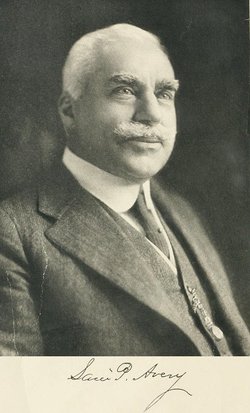
 Samuel Putnam Avery III (often historically referred to as Samuel Putnam Avery Jr., October 7, 1847 - September 25, 1920) was a prominent American art dealer,
connoisseur, and philanthropist.
Samuel Putnam Avery III (often historically referred to as Samuel Putnam Avery Jr., October 7, 1847 - September 25, 1920) was a prominent American art dealer,
connoisseur, and philanthropist.Queer Places:
366 5th Ave, New York, NY 10001, USA
61 Woodland St, Hartford, CT 06105, USA
Green-Wood Cemetery, 500 25th Street, Brooklyn, New York 11232-1317 United States
Samuel Putnam Avery III (often historically referred to as Samuel Putnam Avery Jr., October 7, 1847 - September 25, 1920) was a prominent American art dealer,
connoisseur, and philanthropist.
Born in New York City on October 7, 1847, he was the eldest son of Samuel Putnam Avery (1822–1904), the highly influential co-founder and trustee of the Metropolitan Museum of Art. Growing up surrounded by fine arts and architectural prints, he developed an acute appreciation for artistic scholarship early in life.
He joined his father’s successful New York art dealership, taking over the complete day-to-day operations of the gallery in 1888. Upon his father’s death in 1904, he inherited the family's expansive personal collection.
Avery was deeply devoted to the documentation and preservation of early American craftsmanship and decorative arts. His expertise and prestigious status in the collecting community caught the attention of the Horace Walpole Society, an elite group founded in 1909 to study early American decorative arts, architecture, and history. Avery was elected to the society in 1910, though he resigned shortly thereafter in 1912.
In his later years, Avery shifted his focus entirely toward public philanthropy, donating immense collections to regional institutions:
Avery was a massive benefactor to the The Wadsworth Atheneum, Hartford, Connecticut. He provided the funds that ultimately made the Avery Memorial building possible.
He bequeathed a major portion of his combined fine art, bronze, and print collections to The Brooklyn Museum.
He died on September 25, 1920, leaving behind a profound institutional legacy that helped shape early 20th-century American art preservation.
The LGBTQ+ connection to Samuel Putnam Avery III is primarily contextualized through his social circles, his lifetime status as an unmarried bachelor, and his involvement with the Horace Walpole Society.
While there are no surviving explicit historical records confirming Avery’s own personal romantic orientation, his life intersects with early 20th-century queer history in a few notable ways:
Avery never married. In the late 19th and early 20th centuries, wealthy individuals who chose to remain unmarried often navigated elite social and artistic circles where discreet same-sex relationships, "bachelor companions," or "Boston marriages" were common, though rarely documented explicitly due to the social stigmas of the era.
The Horace Walpole Society itself carries a deeply artistic and homosocial legacy. It was named after Horace Walpole, the 4th Earl of Orford, a famous British art historian, antiquarian, and writer of The Castle of Otranto. Walpole is widely recognized by modern historians as having been a gay man, and his letters to male companions are a foundational text in queer literary history. The American society established in his honor in 1909 brought together wealthy male collectors, dealers, and connoisseurs who shared a passion for early design, architecture, and aesthetics.
Avery was elected to the Horace Walpole Society in 1910 alongside several other prominent figures whose lives intersected directly with LGBTQ+ history. For instance, Harry Harkness Flagler (also elected in 1910) was famously the object of affection for the early gay American author and music critic Edward Prime-Stevenson (who wrote the foundational 1908 gay novel Imre: A Memorandum).
Because Avery lived a highly private personal life—moving to Hartford later in life to focus heavily on his massive philanthropic gifts to the Wadsworth Atheneum—his connection remains tightly bound to the broader network of elite, bachelor art connoisseurs who formed the backbone of America's early 20th-century cultural institutions.
References:
Support this project
This website is a passion project researched, developed, and funded entirely by me. If you find the content valuable and would like to help support the ongoing research and hosting costs, any contribution is deeply appreciated.
Thank you for keeping this independent resource alive!
My books on Amazon: Elisa Rolle's books